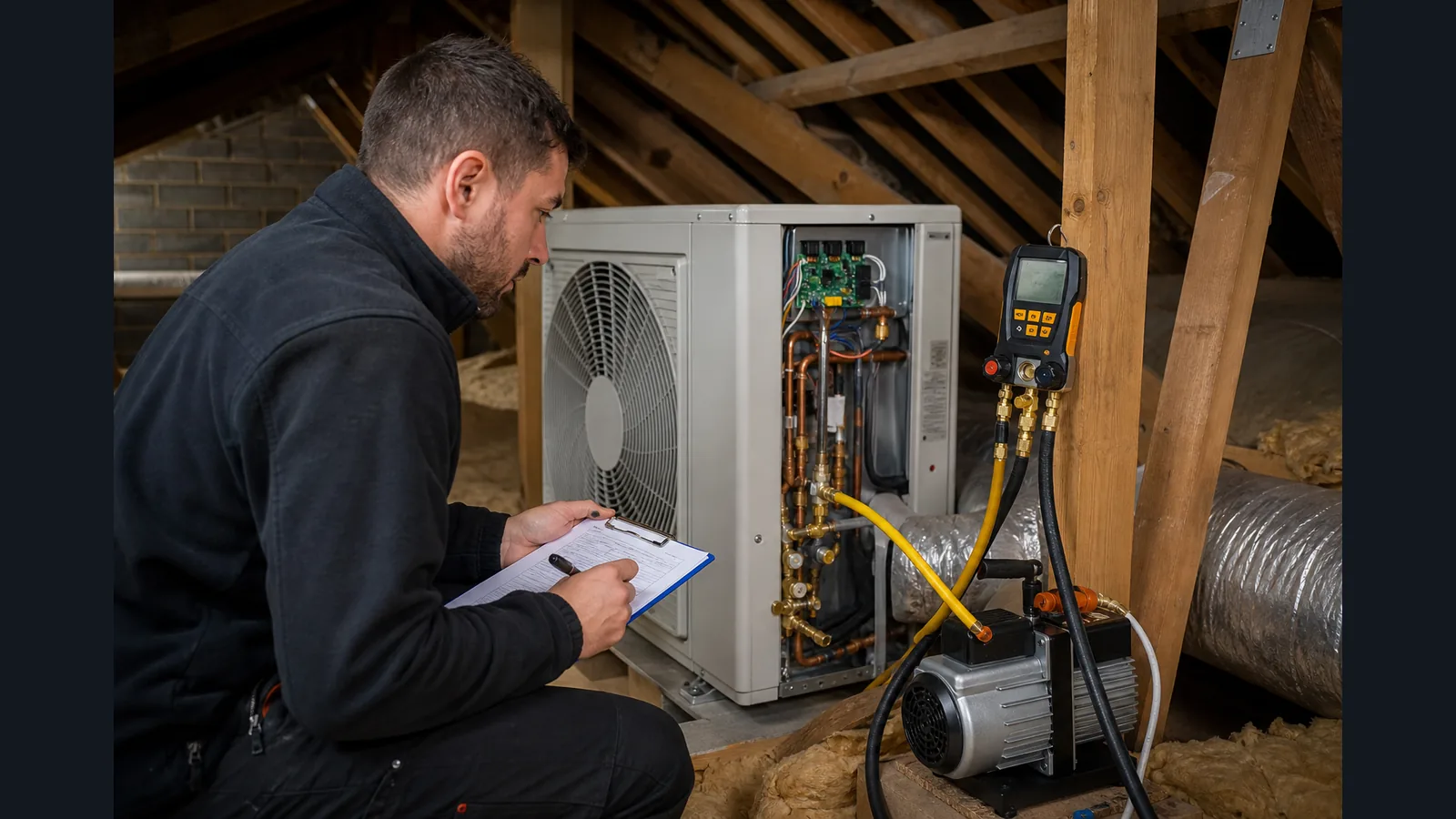
Standing vacuum test procedure UK: 10-minute field checklist
A standing vacuum test—often called a decay test—proves the sealed circuit holds vacuum after the pump is isolated. UK commissioning sequences from Cool Concerns and similar training place deep vacuum after leak testing with oxygen-free nitrogen (OFN) and before charging. Skipping the standing test turns “looks dry on the manifold” into a moisture gamble.
What a standing vacuum test proves
It proves there is no gross leak path and that moisture is not still outgassing fast enough to fail your hold limit. It does not replace OFN pressure testing. It does replace guessing from a compound gauge pinned at the bottom of the scale.
UK context after OFN leak test
Typical teaching: pressure test with OFN per method, release, connect vacuum rig, pull to target with a dedicated micron gauge (not compound scale), isolate pump and hoses from system, monitor rise for at least ten minutes. Cool Concerns evacuation PDF cites 500 microns on new systems and 1000 microns on existing systems when measured with a dedicated gauge.
Step table with timer and isolation
- Confirm cores removed and vacuum-rated hoses sized for the job.
- Connect micron gauge to system port or CRT side port.
- Pull to target (see POE vs mineral guidance in linked articles).
- Close isolation valve on CRT/core tool; isolate pump path.
- Start timer; record microns at 0, 5, 10, 15 minutes.
- Compare rise to hold limit for the oil type in the circuit.
Pass/fail tree for POE vs mineral oil
POE (typical R-410A): pass if hold stays at or below roughly 500 microns after timed decay; fail if rise trends toward or beyond 1000 microns on an opened system. Mineral-oil legacy systems may allow looser hold in some teaching—still use a gauge that can see the rise. When in doubt, re-evacuate rather than charge.
When to re-evacuate
Re-evacuate if rise exceeds limit, connections were disturbed, pump oil is wet, or you never achieved target before isolation. Do not “average away” a climbing curve.
Equip for repeatable UK decay tests
The Elitech VGW-mini HVAC Vacuum Gauge Kit on this site lists 1-micron resolution and a 3-way isolation valve—hardware aligned with system-side decay work. Follow with how to isolate the vacuum pump so the timer measures the circuit, not the hose bundle.
How long must I wait?
Ten to fifteen minutes is common; some methods add time per ton—check your company procedure.
Is a slow rise always a leak?
No. Moisture and hose permeation can creep slowly; pattern and isolation placement distinguish them.
Does F-Gas law mandate microns?
Regulation focuses on competent handling and leak prevention; micron targets are commissioning best practice from industry training.