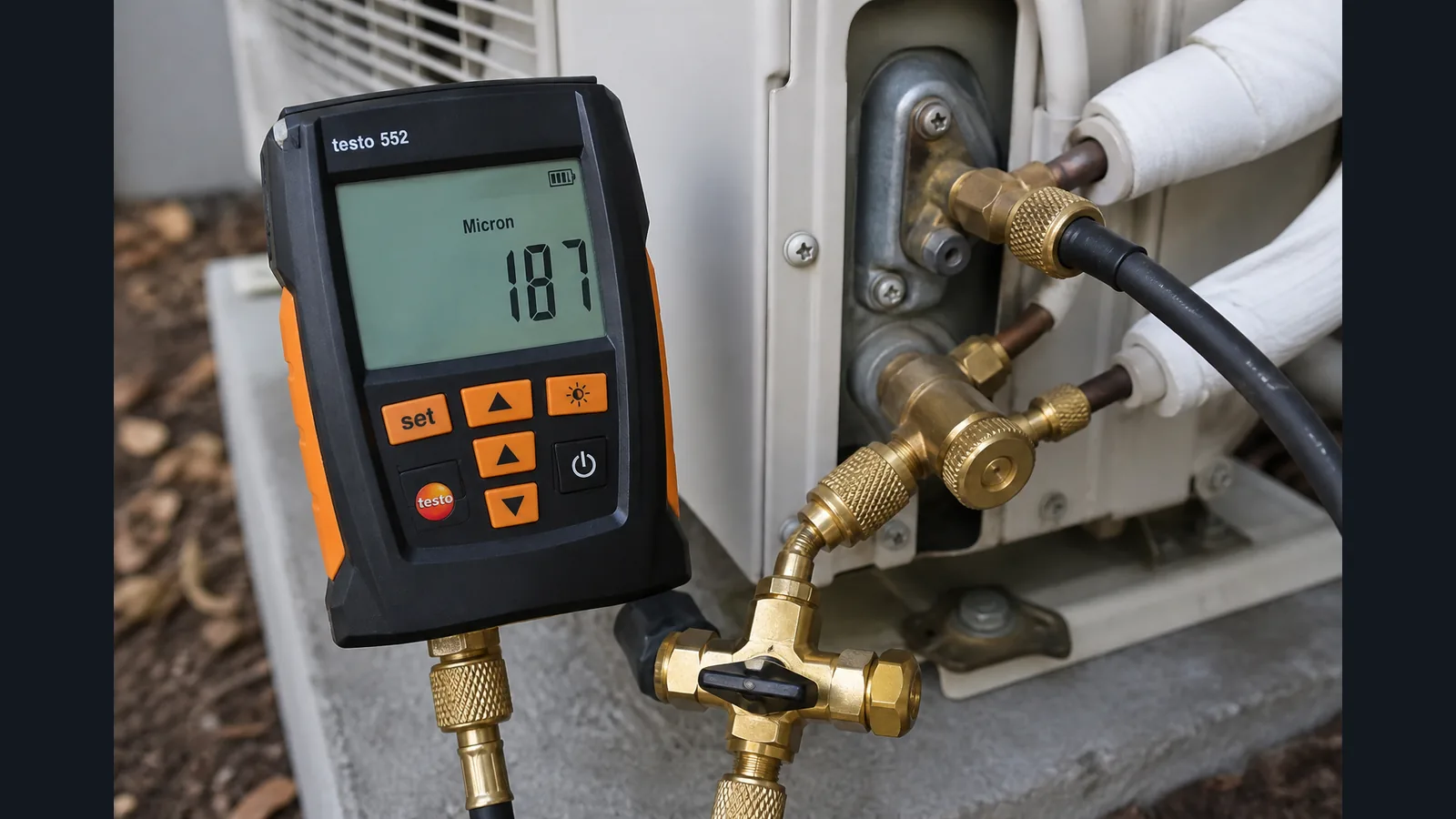
R410a evacuation micron target POE oil: pull, hold and decay numbers
R410a evacuation micron target POE oil jobs use tighter numbers than old mineral-oil habits. Evacuation targets from training sources are tighter than old mineral-oil R-22 habits: commonly cited 250-micron pull with 500-micron decay hold for POE systems versus looser mineral-oil guidance. These are field commissioning numbers from HVAC School and supplier articles—not statutory UK limits—but they explain why your compound gauge habit fails on modern splits.
POE targets vs mineral-oil habits
Mineral-oil systems historically tolerated higher finish vacuum in some teaching (500 pull / 1000 hold cited in places). POE R-410A work often expects 250 pull and 500 or less on decay hold. Decay rising above 1000 microns on an opened POE circuit is widely treated as a problem to fix before charging.
Why hygroscopic POE changes rise interpretation
POE holds water in the oil film. A quick pull can look dry while moisture still outgasses during hold. That is why curve shape and timed decay matter more than a fast number snapshot. SkillCat and similar training note POE’s appetite for moisture as the reason deeper vacuum discipline exists.
Schedule table for common job types
| Job type | Often-cited pull target | Decay hold guidance |
|---|---|---|
| New residential split (POE) | 250–500 microns | Hold at or below 500 microns |
| Opened service on POE system | 500 microns pull | Decay <1000; investigate if rising |
| VRF/VRV (check OEM) | Below 250 microns in supplier guides | OEM sheet overrides rules of thumb |
Airconspares UK guidance mentions residential splits targeting roughly 300–400 microns in best-practice commissioning. Always cross-check the unit manufacturer when available.
Plateau near 1000 microns symptoms
If the gauge stalls near 1000 microns despite a healthy pump, suspect wet POE in the system, contaminated pump oil, undersized hose path, or leak. Longer pump time alone may not fix wet oil—nitrogen sweep or triple evac may be the correct tool.
Triple evac vs longer pump time
Breaking vacuum with dry nitrogen between pulls helps POE systems release moisture. Endless pumping without isolation tests only wastes diesel. Pair targets with standing test procedure on this site.
Do not charge if decay fails on opened R-410A
Charging over moisture risks acid oil and compressor damage. Use a gauge that resolves fine enough to see hold failure— the listed Elitech VGW-mini kit advertises 1-micron resolution and a 3-way valve for isolation. Read how to read the evacuation curve before you trust a single pull number.
Are these numbers UK law?
No. They are widely cited commissioning practice; F-Gas work still needs qualified handling of refrigerant.
Does R-32 change this article?
R-32 retrofits grow in the UK; always read the label and OEM sheet for the refrigerant actually in the circuit.
Can I use manifold vacuum scale for POE?
Not for verifying 500-micron holds—resolution is insufficient.