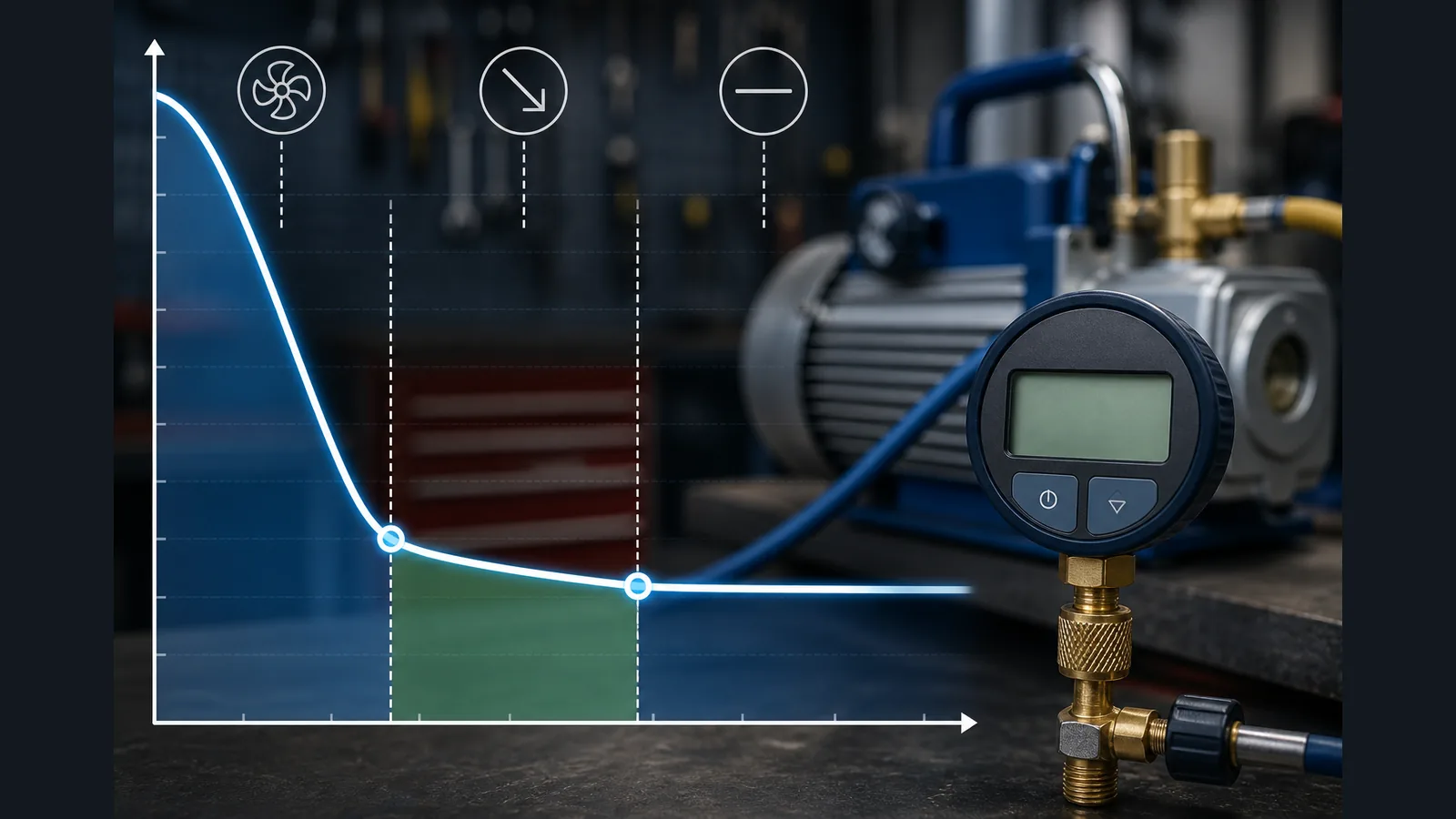
How to read evacuation curve micron gauge before you call the job dry
Reading a micron gauge is not watching a number fall until it stops. An evacuation curve has shape: steep early drop, knee as moisture releases, plateau near target, then decay when isolated. Misreading stabilization for dryness is one of the most common callbacks on split installs—and the reason this site’s buyers search for dedicated digital gauges instead of compound scales.
Four phases: degassing, dehydration knee, target, decay
Phase one is rapid degassing: air and bulk gas leave quickly and the curve falls steeply. Phase two is the dehydration knee where slope flattens as moisture converts and moves—this is where patience matters. Phase three is pull to target (often cited around 250–500 microns depending on oil type). Phase four is decay: isolate and watch rise to judge hold integrity.
CPS Products and Appion field articles describe the same pattern: the curve tells a story over time; a single reading without context misleads.
Flat decay vs slow rise vs sharp rise
- Flat decay after isolation: good sign if you are already at target; verify duration meets your hold rule.
- Slow continuous rise: often moisture still leaving or hose permeation; may need longer pull or better isolation.
- Sharp rise: suspect leak, open connection, or failed valve—not ready to charge.
5000-micron milestone meaning
Training sources such as AccuTools note that around 5000 microns much degassing has occurred but dehydration may still be underway. Stalling above 5000 can indicate contaminated pump oil or a leak path—not a cue to charge. Below that knee, watch slope change rather than chasing speed.
Pull vs hold when pump overpowers wet system
A large pump on a wet line can hold a artificially low reading while moisture hides in oil films. If the curve will not bend toward target, consider fresh pump oil, nitrogen sweep per your method, or triple evac—not endless horsepower. The gauge shows whether the strategy works.
Simple field logging template
Log time, microns, and notes at: start, 5000 microns, target reached, isolation, +5 min, +10 min, +15 min. A paper column beats memory on callbacks. Digital gauges with 1-micron resolution like the Elitech VGW-mini make small rises visible that analogue manifolds never show.
Review a gauge built for curve reading
If you need repeatable numeric logging on site, review specs on the VGW-mini vacuum gauge kit page. For R-410A target numbers, see the companion R-410A evacuation micron targets article.
When should I restart evacuation?
Restart if decay blows past your hold limit, oil is milky, or connections were opened under deep vacuum against procedure.
Does the kit include logging software?
Check the live product page; this article does not assume an app—paper logs still work.
Is 99.34% degassing a legal standard?
No—it is teaching shorthand from training material, not UK regulation.