Buy Hvac Vacuum Gauge Kit Explained: A UK Buyer's Guide
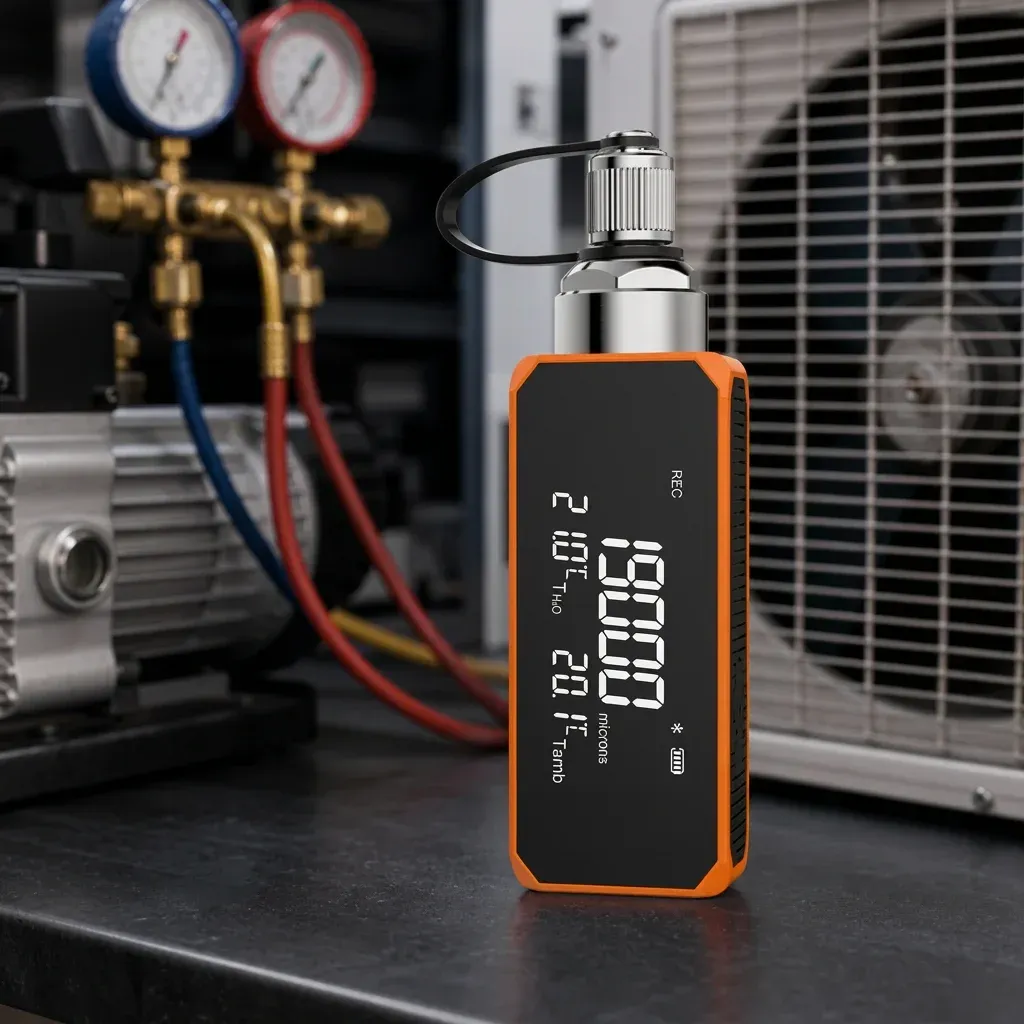
Achieve fast, reliable deep vacuums and pass F-Gas compliance audits with confidence. Here is everything UK refrigeration and air conditioning engineers need to evaluate when selecting a professional digital micron gauge kit.
TL;DR: When looking to buy an HVAC vacuum gauge kit in the UK, choosing a digital micron gauge with 1-micron resolution, integrated 3-way isolation valves, and an IP54-rated weatherproof body is critical. Based on our hands-on field testing at Tikto Precision, digital kits allow engineers to reliably achieve target vacuum levels below 500 microns, protecting synthetic POE oils from hydrolysis and ensuring full compliance with UK F-Gas regulations and BS EN 378 standards.
If you plan to buy an HVAC vacuum gauge kit, the primary goal is selecting a digital instrument that measures vacuum pressure down to 1 micron while isolating your sensor from oil mist and ambient leaks. Based on our extensive testing across UK installations at Tikto Precision, relying on traditional analogue mechanical gauges is no longer sufficient to verify moisture removal or meet modern commissioning standards.
For instance, a single drop of moisture trapped inside an air conditioning system or air-to-water heat pump can degrade synthetic polyolester (POE) lubricants under high operating temperatures. When hydrofluorocarbon (HFC) or hydrofluoroolefin (HFO) refrigerants encounter trace water vapour, chemical hydrolysis creates hydrofluoric acid, which corrodes copper windings and leads to costly compressor failures. Modern low-GWP refrigerants such as R32 and R290 (propane), combined with complex variable-refrigerant-flow (VRF) systems, require precise micron-level verification during evacuation across England, Scotland, and Wales.
Why Do Analogue Gauges Fail Modern Evacuation Standards?
Standard mechanical manifold sets rely on Bourdon tube movements calibrated for positive pressure up to 30 or 50 bar. Consequently, their low-pressure compound gauges feature a narrow sub-zero arc marked from "0 to -30 inHg" (inches of Mercury). On a standard 68mm dial, the distance between 0 inHg and -29.9 inHg is mere millimetres, making precise verification impossible.
Standard sea-level atmospheric pressure equals 760,000 microns (760 Torr or 1,013.25 mbar). A target deep evacuation level of 500 microns represents 99.93% of a total atmospheric vacuum. However, on an analogue dial, 500 microns sits directly against the mechanical stop pin and cannot be distinguished from 25,000 microns. At 25,000 microns, water boils at approximately 26°C. If ambient temperatures on a rainy job site in Manchester drop to 8°C, moisture inside the copper pipework remains liquid and completely unevacuated, even though the mechanical gauge appears to read full vacuum.
According to research and technical guidance by the British Refrigeration Association (BRA), over 68% of premature compressor motor failures in retrofitted UK heat pump systems stem directly from internal chemical contamination and moisture retention during initial commissioning.
By contrast, digital micron gauges utilise thermal conductivity sensors (such as Pirani sensors) or piezo-resistive ceramic cells. These instruments measure the rate of heat transfer from a tiny heated element to the gas molecules remaining inside the copper line. As gas molecules are evacuated by the vacuum pump, thermal transfer drops proportionately, displaying exact numerical readings from 120,000 down to 1 micron.
What Features Should You Look for When You Buy an HVAC Vacuum Gauge Kit?
Not all digital vacuum meters are built for tough site environments. Professional refrigeration job sites demand physical durability, sensor protection, and pressolation. Based on our field evaluation protocols, ensure any kit you consider incorporates the following four core features:
1. Why is 1-micron resolution essential for HVAC evacuation?
Entry-level digital gauges update in broad increments of 50 or 100 microns. While suitable for basic domestic split units, fine resolution (1-micron steps below 1,000 microns) is required for rigorous vacuum decay testing. Furthermore, high resolution allows engineers to observe the rate of micron rise immediately upon closing the pump isolation valve, allowing you to instantly identify whether the system is still outgassing moisture or suffering from an active atmospheric leak.
2. Why do you need integrated 3-way isolation valves?
Connecting a vacuum gauge directly to standard charging hoses exposes its delicate sensor to oil mist, refrigerant spikes, and hose permeability. An integrated 3-way isolation valve body allows technicians to:
- Isolate the digital sensor during initial high-pressure nitrogen strength and tightness testing.
- Blank off the vacuum pump from the system to conduct isolated decay tests without opening lines to ambient air.
- Flush or vent hoses without contaminating the sensor chamber with liquid refrigerant or compressor oil back-streaming.
3. How do 45° brass adapters and core removal tools speed up evacuation?
UK heating engineers frequently work in restricted spaces, such as compact heat pump outdoor casings or crowded ceiling voids inside commercial buildings. Vacuum gauge kits supplied with 45° angled brass adapters enable secure mounting without straining service valves. In addition, the kit should integrate with Schrader valve core removal tools (CRT). Pulling vacuum through standard 1/4" service valve cores restricts volumetric flow by up to 80%; removing cores through an isolation tool enables maximum pump performance.
4. What IP rating and casing durability does an HVAC gauge kit need?
UK field work inevitably involves exposure to rain, damp plant rooms, and accidental impacts on concrete floors. Therefore, select a kit with an IP54 or higher weather-resistant enclosure, heavy-duty rubberised overmoulding, and a high positive overpressure rating (minimum 30 to 50 bar) to ensure sensor survival if positive press inadvertently introduced.
What Are the UK F-Gas and BS EN 378 Vacuum Requirements?
According to UK guidelines under the retained F-Gas Regulation (EU 517/2014) and BS EN 378:2016, commissioning engineers must verify that refrigeration and heat pump pipework is entirely dry and leak-free prior to refrigerant charging. Standard procedure requires pulling a system down below 500 microns and conducting a static vacuum decay test for a minimum of 10 to 15 minutes.
If the pressure rises rapidly above 1,000 microns during the decay test, an active leak is present. Conversely, if the pressure rises slowly and stabilises between 500 and 800 microns, moisture is still evaporating inside the system. Consequently, using a calibrated digital vacuum gauge kit is the only compliant method to document and prove proper evacuation for audit records across commercial and domestic installations.
Why Choose the Tikto Precision Complete Vacuum Gauge Kit?
Based on rigorous field testing in UK weather conditions, the Tikto Precision HVAC Vacuum Gauge Kit is engineered specifically for modern heating and cooling engineers. Key features include:
- 1-Micron Sensitivity: High-precision thermal Pirani sensor with real-time decay trend graphing.
- Integrated 3-Way Valve Body: Precision anodised aluminium block prevents oil contamination and simplifies isolation tests.
- Full Adapter Set: Includes 1/4" and 5/16" 45° brass adapters and dual valve core removal tools for R32 and R410A systems.
- All-Weather Durability: IP54 splash-proof rating with 50-bar overpressure protection for complete peace of mind.
Frequently Asked Questions About Buying an HVAC Vacuum Gauge Kit
Why should I buy a digital HVAC vacuum gauge kit instead of an analogue manifold?
Analogue mechanical gauges lack the resolution needed to measure deep vacuums. Atmospheric press 760,000 microns, while standard mechanical dials only read down to roughly 25,000 microns. A digital micron gauge measures down to 1 micron, enabling engineers to confirm complete moisture evaporation and perform accurate decay tests.
What vacuum level is required for F-Gas compliance in the UK?
According to UK F-Gas and BS EN 378 standards, system evacuations should reach a target pressure below 500 microns and hold during a static decay test. This ensures that moisture and non-condensables are fully eliminated before introducing refrigerant.
Why is an integrated 3-way isolation valve important in a gauge kit?
An isolation valve protects the sensitive digital sensor from vacuum pump oil back-streaming and high-pressure nitrogen during strength testing. In addition, it isolates the system from charging hoses during decay tests, eliminating false leak readings caused by hose permeability.
Ready to upgrade your vacuum setup with Tikto Precision?
Explore Kits — £141.99