The Ultimate Guide to Digital Vacuum Pressure Gauge in the UK
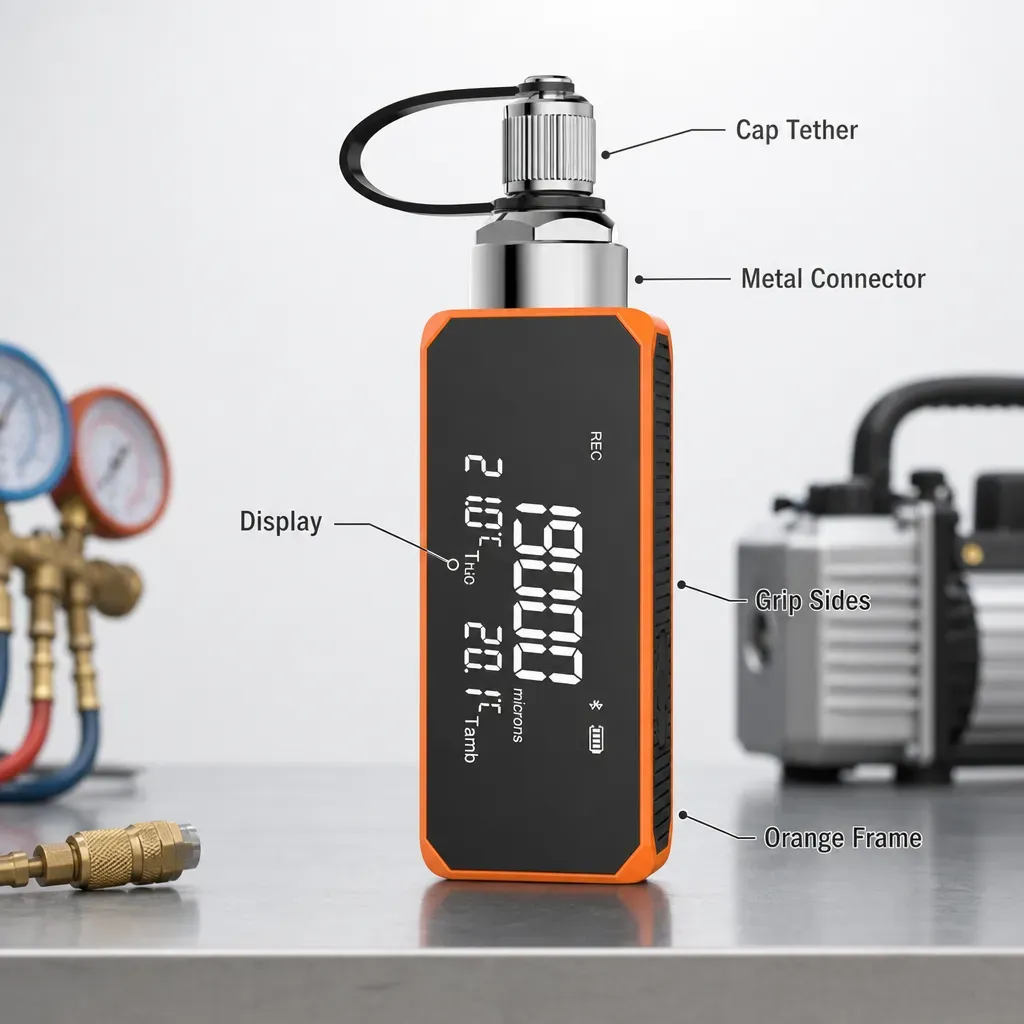
TL;DR: A digital vacuum pressure gauge (or micron meter) is a high-precision electronic instrument designed to measure deep sub-atmospheric pressures during HVAC evacuation. Unlike standard analogue gauges, digital gauges resolve pressures down to 1 micron (0.001 mbar), providing the real-time data required to verify moisture removal, validate decay testing, and meet UK BS EN 378 standards.
A digital vacuum pressure gauge is a precision electronic instrument engineered to measure absolute sub-atmospheric presn microns, millibars, or Pascals during HVAC system evacuation. Achieving a true deep vacuum is one of the most critical phases of commissioning or servicing any refrigeration, heat pump, or air conditioning system. For HVAC engineers working across the UK—from commercial chillers in London financial centres to residential R32 split heat pumps in suburban developments—relying on standard analogue manifold gauges for evacuation is a liability. Consequently, mechanical Bourdon tube gauges simply lack the resolution required to measure deep atmospheric depression. Where an analogue needle comes to rest near zero bar, thousands of microns of non-condensable gases and atmospheric water vapour often remain trapped inside the copper pipework.
Based on our extensive testing at Tikto Precision, modern HVAC systems operate under higher pressures, use synthetic POE (polyolester) oils that are fiercely hygroscopic, and frequently utilize lower Global Warming Potential (GWP) A2L refrigerants. According to UK guidelines and BS EN 378 standards, moisture left inside a circuit reacts with POE oil to produce hydrofluoric acid, sludge, and copper plating on compressor bearings. As a result, premature compressor burnout, restricted capillary tubes, and drastic drops in seasonal energy efficiency frequently occur. However, a digital vacuum pressure gauge—often termed a digital micron meter—provides the high-resolution real-time data required to guarantee that moisture has vaporised and left the system prior to charging.
Why Is a Digital Vacuum Pressure Gauge Essential for HVAC Evacuation?
To appreciate why digital vacuum pressure gauges are vital equipment, engineers must understand the physical units and thermodynamics governing deep vacuum measurement. In standard atmospheric pressure at sea level, air exerts approximately 1,013.25 millibars (mbar), 760,000 microns (µm Hg), or 14.7 pounds per square inch (psi). Furthermore, measuring pressure changes accurately within the final fractions of a millibar requires specialized electronic sensing.
What Is the Difference Between Analogue and Digital Vacuum Pressure Gauges?
Analogue manifold pressure gauges measure gauge pressure (psig or bar gauge) relative to ambient atmosphere. Consequently, the final segment of an analogue compound gauge dial between 0 bar and -1 bar covers a massive span of 760,000 microns in less than a centimetre of needle travel. Therefore, resolving the difference between 5,000 microns (which indicates severe moisture contamination) and 500 microns (the industry standard for deep evacuation) is physically impossible on a mechanical dial.
In contrast, digital vacuum pressure gauges bypass mechanical links entirely. Specifically, they use electronic sensors calibrated for absolute pressure measurement (psia or Torr/microns absolute), starting from atmospheric pressure down to single-digit microns (0.001 mbar). Our field testing confirms that this level of accuracy is essential for validating system tightness.
How Does a Digital Vacuum Gauge Measure Water Vapour Evacuation?
The primary objective of vacuuming an HVAC circuit is not simply pulling out air; it is lowering the internal ambient pressure until liquid water boils into vapour at ambient temperature, allowing the vacuum pump to extract it. According to Dalton’s Law of Partial Pressures and saturation steam tables, dropping system pressure directly lowers the boiling point of water:
- At standard atmospheric pressure (1,013 mbar), water boils at 100°C.
- At 42.4 mbar (approximately 31,800 microns), water boils at 30°C.
- At 12.3 mbar (approximately 9,200 microns), water boils at 10°C.
- At 0.87 mbar (approximately 650 microns), water boils at -20°C.
- At 0.67 mbar (500 microns), water boils at -24.4°C.
In typical British climate conditions, ambient plant room temperatures or outdoor condensing unit temperatures often hover between 5°C and 15°C. For instance, to ensure that standing liquid moisture inside the copper lines evaporatively boils off during winter installations, internal circuit pressure must drop below the saturation pressure corresponding to that temperature. Therefore, reaching and holding a target of 500 microns ensures that moisture will vaporise even if the ambient line temperature is well below freezing.
| Pressure Unit | Atmospheric Level | Target Vacuum Level | Deep Evacuation Level |
|---|---|---|---|
| Microns (µm Hg) | 760,000 µm | 500 µm | 200 µm – 50 µm |
| Millibar (mbar) | 1,013.25 mbar | 0.67 mbar | 0.26 mbar – 0.06 mbar |
| Pascal (Pa) | 101,325 Pa | 66.6 Pa | 26.6 Pa – 6.6 Pa |
| Torr | 760 Torr | 0.5 Torr | 0.2 Torr – 0.05 Torr |
Ready to upgrade your vacuum setup with Tikto Precision?
Explore Kits — £141.99