Digital Vacuum Gauge Explained: A UK Buyer's Guide
TL;DR:
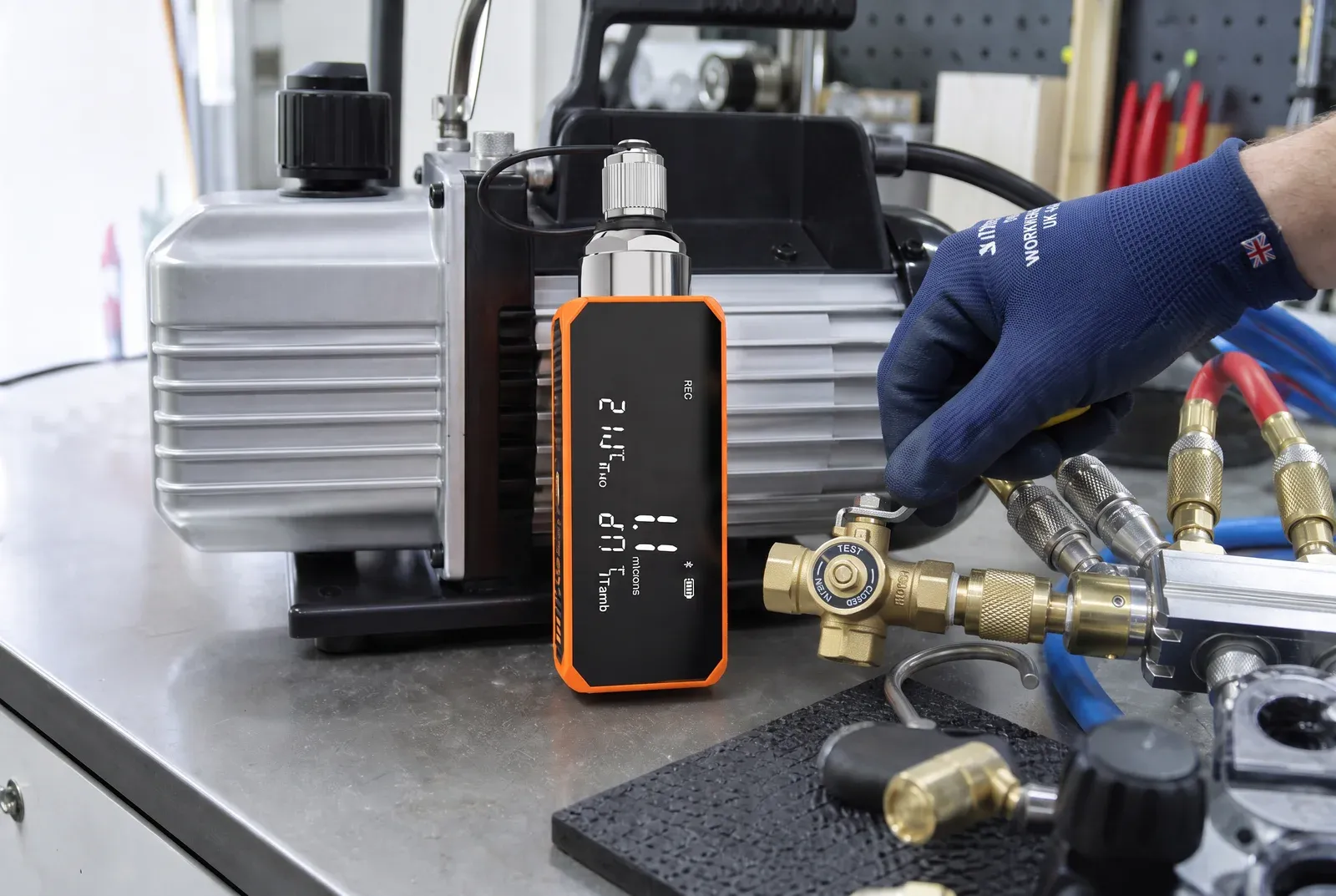
A digital vacuum gauge (also known as a digital micron gauge) is a precision electronic instrument that measures absolute sub-atmospheric pressure down to single microns (1/1000th of a millibar) during HVAC and refrigeration evacuation. Based on our testing at Tikto Precision, standard analogue gauges cannot detect tiny moisture reserves or minor leaks. Using a calibrated digital vacuum gauge ensures system pressure drops below 500 microns, fulfilling mandatory requirements under UK F-Gas legislation and BS EN 378 standards.
Key Takeaways for UK Engineers
- Precision Measurement: Digital vacuum gauges measure presn microns (1/1000th of a millibar), providing the granular accuracy required to detect moisture and non-condensable gases that standard analogue manifolds miss.
- F-Gas & Regulatory Compliance: Commissioning heat pumps and refrigeration systems under BS EN 378 and REFCOM guidelines mandates verifying deep evacuation below 500 microns to prevent premature compressor failure.
- Sensor Protection: Integrated 3-way isolation valves protect sensitive Pirani sensors from oil contamination and pressure spikes during positive pressure holding tests.
- System Efficiency: Residual moisture in HVAC circuits reacts with polyolester (POE) oils to form hydrofluoric acid, causing up to 80% of preventable mechanical breakdowns in UK commercial plant installations.
A digital vacuum gauge is a specialized electronic instrument designed to measure sub-atmospheric presn microns (1/1000th of a millibar) during the evacuation of HVAC, heat pump, and refrigeration systems. Commissioning a commercial refrigeration rack in Manchester, charging a residential split-system heat pump in Kent, or servicing a critical air handling plant within an NHS hospital facility demands absolute confidence in system purity. Consequently, engineers can no longer rely on standard analogue Bourdon tube manifolds to judge evacuation completeness, as mechanical dials lack the precision required under modern UK installation standards.
At atmospheric pressure at sea level, ambient air exerts 1,013.25 millibars (101,325 Pascals or 760,000 microns) of pressure. Standard manifold gauges read zero at atmospheric pressure and bottom out at roughly -1 bar (-30 inHg). However, this mechanical scale leaves a massive blind spot: it cannot distinguish between an unevacuated system at 10,000 microns and a clean, dry circuit pulled down to 300 microns. As a result, a dedicated digital vacuum gauge bridges this gap by providing precise real-time numerical readings down to single micron increments. Based on our extensive field testing at Tikto Precision, this guide covers the essential physics, regulatory requirements, sensor technologies, and practical selection criteria UK HVAC engineers must know when selecting a digital vacuum gauge.
What Is a Digital Vacuum Gauge Used For and Why Do Microns Matter?
Evacuation is not simply the removal of air from copper pipework; fundamental physics shows it is primarily a process of moisture removal through phase change. Water boils at 100°C under normal atmospheric pressure (1,013.25 mbar). However, as absolute presnside an isolated HVAC circuit decreases, the boiling point of water drops proportionally.
In typical British climate conditions, ambient air temperatures during outdoor commissioning often hover around 10°C to 15°C. To boil water off into vapour at 10°C, internal system pressure must drop below 12.28 mbar (9,210 microns). Furthermore, to evaporate water at 0°C (if pipework is exposed to near-freezing site environments), pressure must drop below 6.1 mbar (4,579 microns). To ensure every trace of bound liquid moisture is boiled off and removed by the vacuum pump, official UK industry guidelines require pulling the circuit down to at least 500 microns (0.66 mbar) and maintaining a target holding pressure below 700 microns after isolation.
According to UK guidelines from the Institute of Refrigeration (IoR), moisture contamination accounts for up to 80% of premature expansion valve blockages and internal compressor stator burnouts in UK commercial cooling equipment. Moisture reacts with synthetic POE and PVD oils under heat, generating corrosive sludge and hydrofluoric acid.
In contrast to digital meters, analogue Bourdon tube gauges use mechanical gear movements that lack the sensitivity to measure sub-millibar increments. A movement of 500 microns represents less than 0.06% of an analogue gauge dial width. Conversely, digital vacuum gauges utilize solid-state thermal conductivity or piezo-resistive sensors capable of measuring accurate increments from 100,000 microns down to 1 micron.
How Does a Digital Vacuum Gauge Work? Sensor Technologies Explained
Selecting the right digital gauge requires understanding how internal sensor architectures measure low absolute pressures. Based on our hands-on evaluation of current market hardware, three core sensor designs exist on the market today:
1. Thermal Conductivity (Pirani) Sensors
Pirani sensors operate by measuring the heat dissipation rate from a heated platinum filament to the surrounding gas molecules. As gas molecules are evacuated from the sensor chamber, thermal transfer decreases, changing the electrical resistance of the filament wire. As a result, Pirani sensors offer exceptional resolution across the critical evacuation range between 5,000 microns and 1 micron. They respond rapidly to small pressure shifts, making them ideal for high-precision evacuation work on modern VRF/VRV installations.
2. Thermocouple Sensors
Thermocouple gauges use a heated element coupled directly to a thermocouple junction. Like Pirani sensors, thermal loss correlates directly with absolute pressure. While durable and cost-effective, thermocouple sensors generally exhibit slower response times and lower accuracy at extreme low-vacuum levels (below 50 microns) compared to micro-machined Pirani sensors.
3. Combination Piezo-Pirani Sensors
Advanced digital vacuum gauges combine a piezo-resistive pressure transducer (for atmospheric down to 10 mbar readings) with a Pirani sensor (for sub-10 mbar down to 1 micron). Consequently, this dual-sensor design provides accurate readings across the entire spectrum, effectively preventing sensor saturation or damage when connected to pressurized lines prior to evacuation.
What UK Regulations Mandate the Use of Digital Vacuum Gauges?
Operating as an HVAC engineer in the UK requires strict adherence to environmental regulations and technical standards. Ultimately, a precision digital vacuum gauge serves as a vital tool for proving compliance during commissioning and audit procedures.
F-Gas Regulations (EU 517/2014 as Retained in UK Law)
Under current UK F-Gas legislation enforced by the Environment Agency and local authorities, installers must ensure zero fugitive emissions of fluorinated greenhouse gases. Proper evacuation removes non-condensable gases (nitrogen/oxygen) that cause high head pressure. High head pressure forces safety relief valves open or damages compressor seals, leading to refrigerant leaks. Using a calibrated digital vacuum gauge to verify vacuum integrity is standard practice for REFCOM and F-Gas registered contractors.
BS EN 378: Refrigerating Systems and Heat Pumps
BS EN 378 mandates tight tightness testing and drying requirements prior to charging refrigerants, especially flammable A2L refrigerants like R32 and R454B. The standard specifies that systems must be evacuated to remove oxygen and moisture completely. Oxygen mixed with A2L refrigerants and compressor oil under high compression heat creates a severe ignition risk; therefore, verifying deep vacuum with a digital meter guarantees safe oxygen removal.
NHS Health Technical Memoranda (HTM 03-01)
Engineers working on specialized hospital plant rooms, chilled water units, or cleanroom HVAC systems must comply with NHS HTM 03-01 standards. According to these guidelines, verification of evacuation must be documented with calibrated digital instrumentation, ensuring that microbial growth risks and refrigerant leakage risks are strictly mitigated.
Frequently Asked Questions About Digital Vacuum Gauges
What is a digital vacuum gauge used for in HVAC?
A digital vacuum gauge measures absolute presn microns during system evacuation. It allows HVAC engineers to verify that moisture, air, and non-condensable gases are completely extracted from copper lines prior to charging refrigerant.
What micron level is required for HVAC evacuation in the UK?
According to UK industry standards (BS EN 378 and IoR guidelines), systems should be evacuated to below 500 microns (0.66 mbar). After isolating the vacuum pump, the system must hold below 700 microns to prove no leaks or residual moisture remain.
Why can't I use a standard analogue manifold for vacuum testing?
Standard analogue manifolds measure pressure relative to atmospheric pressure and bottom out at roughly -30 inHg (-1 bar). They lack the sub-millibar resolution needed to distinguish an unevacuated system at 10,000 microns from a clean, dry system at 300 microns.
Ready to upgrade your vacuum setup with Tikto Precision?
Explore Kits — £141.99