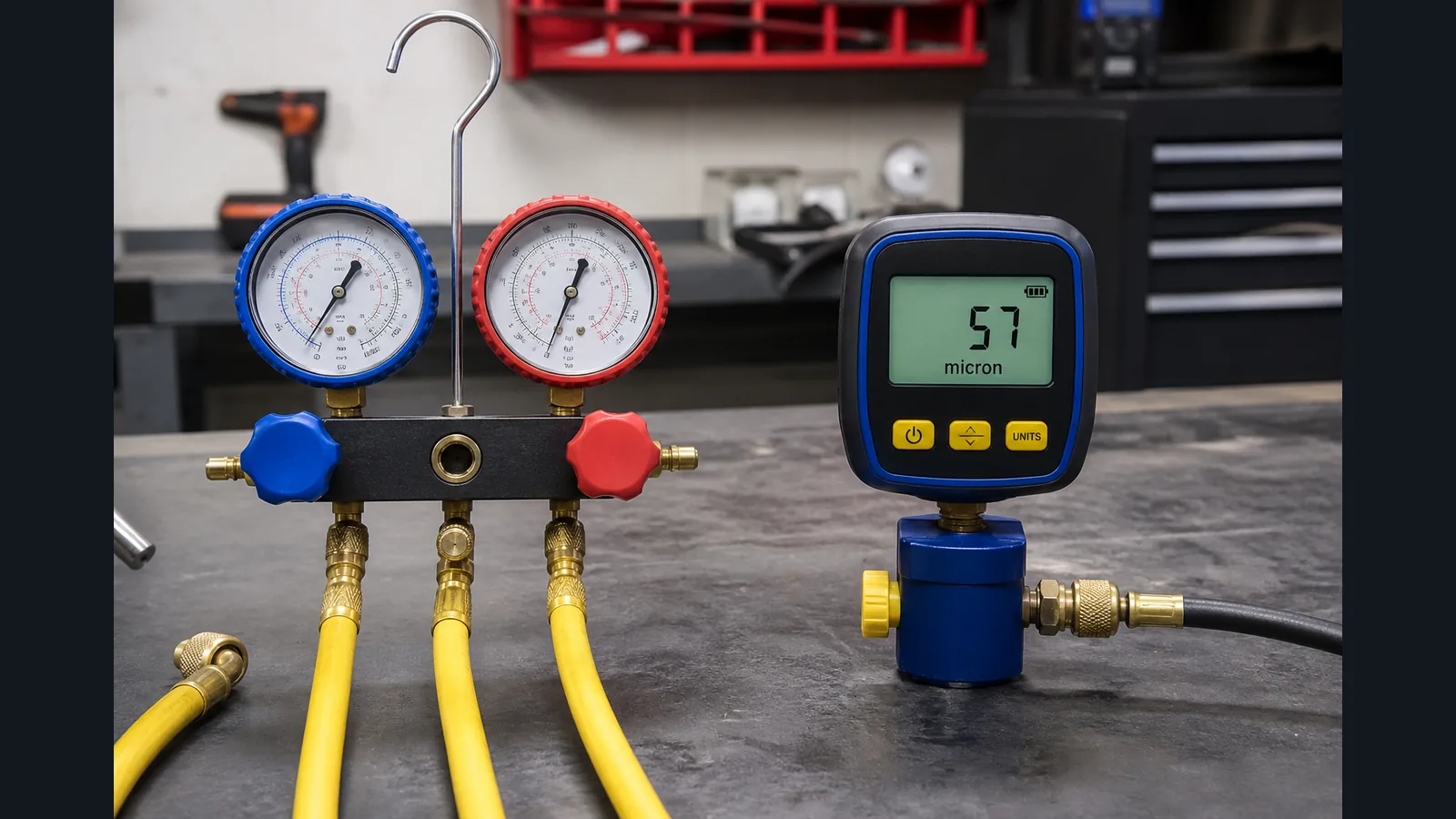
Can manifold gauge measure vacuum HVAC? Resolution limits and what to use instead
If you are asking whether a manifold gauge can measure vacuum in HVAC work, the honest UK field answer is: not to the depth modern commissioning expects. A compound gauge on a yellow hose tells you the line is below atmospheric pressure. It does not prove you have reached a 500-micron finish line suitable for POE-oil R-410A circuits or a meaningful standing vacuum test.
Direct answer: compound gauges lack resolution for deep vacuum
Training material from Cool Concerns and supplier guides repeatedly state that standard manifold compound scales are the wrong instrument for verifying deep vacuum. The needle may sit at the bottom of the vacuum side and look convincing while the system still holds thousands of microns of moisture and non-condensables. That is the resolution gap—not a brand argument, but physics.
Industry teaching commonly cites manifold vacuum scales bottoming out around 3386 microns or higher while evacuation targets for many POE systems sit at 500 microns or below for the decay hold. The finish line can be seven times tighter than the gauge can resolve.
Resolution table: manifold bottom-out vs micron gauge range
| Instrument | Typical usable vacuum indication | Common commissioning target |
|---|---|---|
| Analogue compound manifold | Often 3000+ microns at scale bottom | 500 microns decay hold (POE) |
| Dedicated digital micron gauge | 1–999999 microns (model dependent) | 250 pull / 500 hold cited for POE |
| Digital manifold with vacuum sensor | Better than analogue, placement dependent | Still needs system-side port discipline |
The Elitech VGW-mini kit listed on this site advertises 1-micron digital resolution with a 3-way isolation valve—specs aimed at system-side reading, not pump-side guesswork through a 1/4-inch manifold path.
Side-by-side workflow: manifold-only vs gauge at system port
Manifold-only workflow: connect hoses, open valves, watch compound gauge drop, assume dryness when the needle stops moving. System-port workflow: remove cores where safe, attach a micron gauge directly to the circuit (or CRT side port), pull to target, isolate pump and hoses, then run a decay test on the system side.
Airconspares and other UK suppliers emphasise connecting the micron gauge to the refrigeration system—not the pump or manifold—for accurate system-side readings. Reading at the pump hides hose permeation and valve leakage that never appears on the compound scale.
False confidence scenarios technicians recognise
- Needle parked at vacuum scale bottom while moisture still outgasses above 1000 microns.
- Pulling through a 1/4-inch manifold path while the gauge sits on the pump side.
- Assuming a digital manifold display replaces a standing decay test without isolation.
- Charging after “good enough” vacuum because the analogue scale cannot show the knee in the curve.
When digital manifolds still need a separate system-side gauge
Some digital manifolds include vacuum sensors and improve on legacy analogue habits. They still fail the job when the sensor stays on the wrong side of isolation, when hoses are undersized, or when you skip the decay phase because the display looked stable for thirty seconds. A dedicated gauge with isolation hardware supports the standing test this persona cares about.
Review the kit if you need 1-micron resolution on the circuit
If your workflow has outgrown compound-scale confidence, review the published specs on the Elitech VGW-mini HVAC Vacuum Gauge Kit detail page: 1-micron resolution, 3-way valve, and adapter set for UK field rigs. For background on how digital micron meters differ from manifold scales, see the existing digital vacuum gauge explained article on this site.
Can any manifold ever prove 500 microns?
Not reliably on the compound scale. Some integrated digital manifolds help, but system-side placement and decay testing still matter.
Where should the gauge sit during evacuation?
On the system service port or CRT side port, isolated from the pump for the standing test—not only on the pump inlet.
Does this site sell manifold sets?
This listing is a dedicated digital micron gauge kit, not a four-hose manifold bundle.